We Make Magic.
“Any sufficiently advanced technology is indistinguishable from magic.”
— Arthur C. Clarke
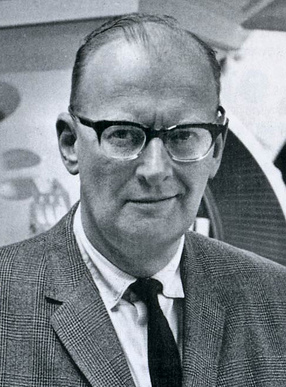
Clarke wrote the brief. We execute. The hard part of any technology is the part nobody should have to see. We build that part, and then we hide it, so that what’s left simply works. When it’s done properly, it doesn’t look like engineering. It looks like magic.
Sir Arthur C. Clarke, 1917–2008.
The man who wrote our brief
Most people know Arthur C. Clarke for one line about magic. Fewer know he also did the engineering. In 1945 he took an orbit other people had already calculated and saw what it was for: a relay that could carry radio signals around the whole planet. He spent the rest of his life describing the future to people who hadn't got there yet.
- WWII
As an RAF radar officer, he worked on the early Ground Controlled Approach system, which talked pilots down to land through fog and cloud. He later turned it into a novel, Glide Path.
- 1945
In “Extra-Terrestrial Relays”, published in Wireless World, he showed that three satellites parked about 36,000 km up could relay signals around the whole planet. He never patented it. Today that orbit is sometimes called the Clarke Orbit.
- 1953
Childhood’s End. The aliens arrive, and the story turns out to be about us.
- 1956
He moved to Ceylon, now Sri Lanka, for the diving and the Indian Ocean. He stayed for the rest of his life.
- 1962
Profiles of the Future. This is where his laws began, and the third was added in a later edition: “Any sufficiently advanced technology is indistinguishable from magic.”
- 1968
2001: A Space Odyssey, written with Stanley Kubrick and grown from his short story “The Sentinel”. The screenplay was nominated for an Academy Award.
- 1973
Rendezvous with Rama, which won both the Hugo and the Nebula. A vast alien ship passes through the solar system, and a human crew goes aboard to explore it.
- 1979
The Fountains of Paradise, which also won the Hugo and the Nebula. It made the space elevator feel like a construction project rather than a fantasy.
- 2000
Knighted for services to literature. The honour was announced in 1998, and he received it in Colombo.
He died in Colombo in 2008, aged 90.